MODERN INDIA 360°: From Consolidation to Independence for UPSC & MPSC
About Course
“From the Shattered Mughal Hegemony to the Dawn of Sovereignty. Deconstruct the Policies, Master the Resistance.”
Overview
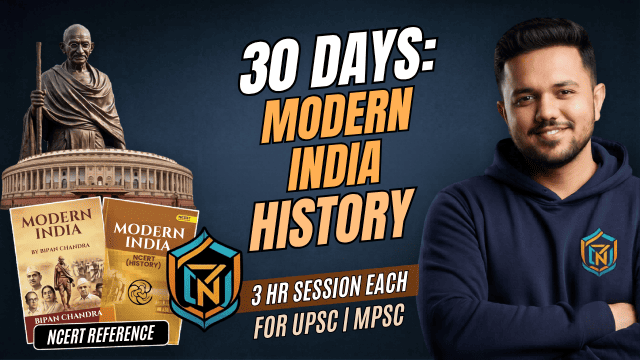
MODERN INDIA 360°: From Consolidation to Independence is a highly specialized, 30-day curriculum explicitly designed to master the highest-yielding component of the history syllabus for both UPSC and MPSC examinations. Modern Indian History has evolved past simple chronological memorization; contemporary examiner patterns demand a deep, structural understanding of colonial economic extractions, administrative transitions, and ideological shifts within the national movement.
Spanning 30 intensive sessions of 3 hours each, this program systematically integrates the analytical depth of Bipan Chandra (Modern India) with foundational Class XI & XII NCERTs (Themes in Indian History – Part III). The course converts a vast historical period into an interconnected web of cause-and-effect dynamics.
Key Pedagogical Pillars
-
The Analytical Synthesis: Merging the narrative strength of Bipan Chandra with the data-heavy structure of NCERTs to equip students for both factual Prelims statements and analytical Mains assertions.
-
The Institutional & Policy Focus: Prioritizing the core engines of British colonial rule—Land Revenue settlements, constitutional experiments (Acts of 1773 to 1947), Civil Services reforms, and Judicial structures—over basic political narrative.
-
Ideological Cross-Mapping: Deep analysis of the intellectual underpinnings of the freedom struggle, mapping the ideological rifts and synergies between Moderates, Extremists, Revolutionaries, Socialists, and Left-Wing movements.
-
MPSC/Maharashtra Core Alignment: Targeted modules tracking Maharashtra’s vanguard role in modern Indian history. This includes the socio-religious reform movements (Jyotirao Phule, Savitribai Phule, Dr. B.R. Ambedkar, Chhatrapati Shahu Maharaj) and regional administrative impacts required for MPSC state services.
Course Deliverables & Structural Matrix
| Phase | Focus Area | Core Text Linkages | Key Value Additions |
| Phase I (Days 1–7) | Decline of Mughals & British Expansion | Bipan Chandra & NCERT Theme III | Mercantilist phases of the East India Company; Subsidiary Alliance and Doctrine of Lapse mechanics; Complete economic critique of colonialism (Drain of Wealth theory, Commercialization of Agriculture). |
| Phase II (Days 8–14) | The 1857 Flashpoint & Socio-Religious Awakening | Bipan Chandra & Old/New NCERTs | Administrative shifts of the 1858 Act; Socio-religious movements analyzed through the lens of rationalism and universalism; Maharashtra’s Satyashodhak Samaj and Dalit emancipation movements. |
| Phase III (Days 15–20) | Genesis of Nationalism & Moderate-Extremist Era | Bipan Chandra & NCERT | Safety-valve theory vs. Lightning conductor reality; Swadeshi movement dynamics; In-depth analysis of Morley-Minto (1909) and Montagu-Chelmsford (1919) institutional traps. |
| Phase IV (Days 21–26) | The Gandhian Epoch & Mass Mobilization | Bipan Chandra & New NCERT Theme III | Strategy shifts: NCM to CDM; Rise of the Left, Trade Unions, and Revolutionary organizations (HRA, HSRA); Tribal and Peasant uprisings across British India. |
| Phase V (Days 27–30) | The Road to Partition, Independence & Integration | Combined Texts | Government of India Act 1935 structural flaws; Quit India Movement decentralization; August Offer, Cripps Mission, Cabinet Mission legal breakdown; Partition mechanics and state integration. |
Target Audience
This course is custom-built for serious civil services candidates who want to move beyond superficial reading. It is engineered for aspirants who want to understand the why behind historical turning points, master constitutional evolution, and secure a flawless score in Modern Indian History.
Course Content
Week 1: Mughal Twilight, European Advent & Expansion (1707–1857)
-
Day 1: Decline of Mughals & Rise of Autonomous States
-
Day 2: Arrival of Europeans & British Hegemony
-
Day 3: British Expansion in South India & Frontier Wars
-
Day 4: British Expansion in North India & Annexation Tools
Week 2: Colonial Impact, Early Resistances & Awakening (Mid-18th to Mid-19th Century)
Week 3: Organized Nationalism & The Incubation of Mass Politics (1858–1922)
Week 4: Political Fragmentation, Constitutional Clashes & Mass Movements (1922–1939)
Week 5: Imperial Crisis, Final Push to Independence & Special Vectors (1939–1947)
Student Ratings & Reviews